A new study, titled ‘Ultrafast all-optical modulation of wide-bandwidth pulses enabled by silicon-metasurfaces‘, published in Opto-Electronic Advances, has revealed how to control light at extremely high speeds with ultra-thin silicon metasurfaces
By designing how light passes through them, the team gained control over a wider range of colours than previously possible. This breakthrough overcomes a limitation in current technology and could support faster internet, improved data processing, and future light-based computing systems.
Controlling light is essential for many modern technologies, with the intensity of light typically being controlled with interference-based devices, in which light waves overlap to create patterns of brighter and darker regions.
While these methods are effective for single colours of light, they struggle when dealing with broadband light, which contains several different colours. In these scenarios, the light waves lose their coordinated behaviour, making conventional techniques less effective. Existing alternatives, such as electro-optic switches, can handle broadband light, but can be bulky, slow, and require complex electronics.
To address this, researchers have turned to metasurfaces, ultra-thin layers of tiny, carefully engineered structures that can control light with high precision. These structures interact with light in a way that enables scientists to shape and direct it on a very small scale.
Metasurfaces can also respond to external stimuli, enabling active control of light. Among multiple approaches, using light itself to control light, otherwise known as all-optical modulation, is desirable as it can operate extremely fast.
Despite its advantages, most metasurface-based approaches face a limitation: they are only effective over a very narrow range of colours. As a result, their usefulness for real-world applications involving broadband signals has been limited.
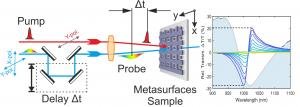
In the study, researchers developed a design strategy to overcome this limitation. By shaping how light is transmitted through a silicon-based metasurface, they created a response that facilitates strong, fast modulation across a wider range of colours. Utilising ultrafast laser techniques, they demonstrated rapid switching of light signals on timescales of trillionths of a second.
This provides a new pathway for compact, high-speed optical devices, with potential applications in faster data transmission, improved sensing, and future light-based computing systems.
This research represents a significant step toward faster, more compact, and more energy-efficient methods for controlling light, with meaningful implications for a variety of technologies.
The ability to rapidly modulate light across a range of colours is valuable for applications such as Light Detection and Ranging (LiDAR), laser mode-locking, and optical communications, where information is transmitted with rapidly modulated light signals.
With global demand for data continuing to grow, there is a strong need for technologies that can process and transmit information faster and more efficiently. The new metasurface-based approach provides a promising pathway to meet these demands.
This technology could also be significant to future optical or ‘light-based’ computing systems. Photonic systems use light to perform operations and can potentially operate at higher speeds with lower energy consumption. The ability to control short, broadband light pulses with high precision is vital for such systems. Compact metasurfaces, which can be integrated onto chips, make this vision more practical by decreasing the size and complexity of optical components.
The next steps for this research include further improvements to the efficiency and speed of modulation, minimising energy requirements, and integrating these metasurfaces into real-world photonic devices and systems. Researchers could also explore new materials and designs to enhance performance.
These findings suggest a shift to more versatile, scalable optical technologies. Overcoming key limitations in how light is controlled enables light to play a central role in communications, computation, and information processing.