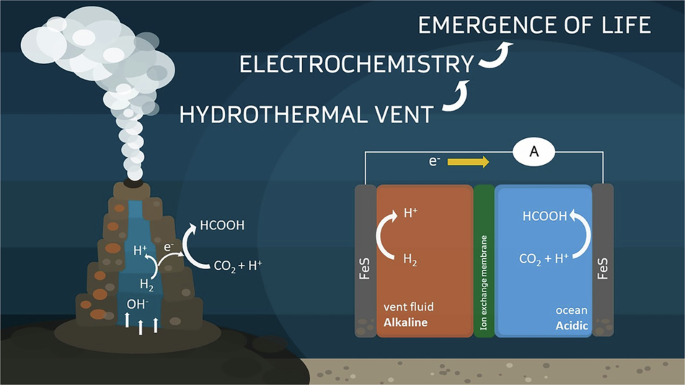
Submarine alkaline hydrothermal vents (SAVs) are geological structures considered plausible sites for life emergence, here a life-like thermodynamic disequilibrium is generated by the presence of two fluids with different pH and composition across opposite surfaces of a mineral membrane. The redox potential generated can drive the formation of organic molecules by coupling CO2 reduction with H2 oxidation. In this work, we propose a novel electrochemical model for SAVs, treating them as short-circuited fuel cells. Using two iron sulfide electrodes exposed to the different environments, we measured the potential difference (Uc) generated in the cell by the pH and redox gradients, namely the open circuit potential difference between two electrodes. Short-circuiting the electrodes equalized their potential, i.e. the mixed potential (Em) and allowed a current to flow and thus two or more redox reactions to proceed. Under far-from-equilibrium conditions, spontaneous current generation was observed for the first time ever, leading to the formation of formic acid. Our results show the active role of the mineral barrier as the site where geochemical energy is dissipated and converted into the very first protobiotic chemistry.