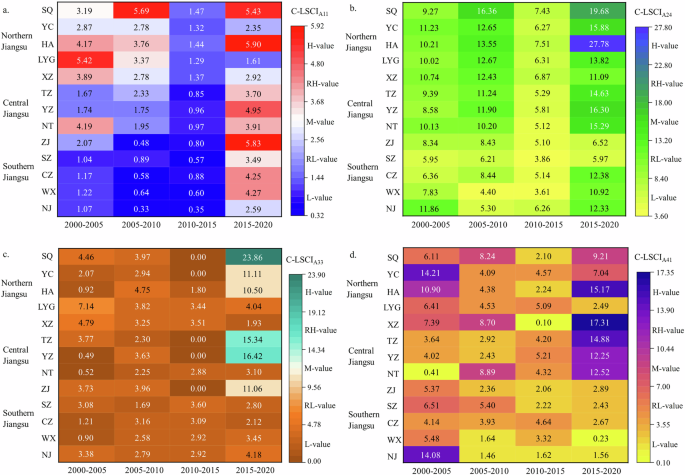
Urban expansion, as a key spatial manifestation of rapid urbanization, often triggers competition among production, living, and ecological spaces and thereby intensifies land space conflict. However, how conflict dynamics respond to urban expansion over time, and how multi-dimensional urbanization drivers shape conflict intensity, remain insufficiently clarified. This study develops an integrated analytical framework with two complementary modules: (i) a spatial-response module that evaluates how changes in land space conflict respond to urban expansion across grid units and their city-level aggregation, and (ii) an urbanization-driven module that examines how urbanization subsystems and their interactions drive conflict intensity at the city level. Taking Jiangsu Province as a rapidly urbanizing case, we analyze the period 2000–2020. Results show that land space conflict intensity (LSCI) increased continuously, whereas urban expansion intensity (UEI) and changes in LSCI (LSCIc) followed an inverted U-shaped temporal trajectory. LSCIc is positively associated with UEI, with an observable lag effect, and high-response areas shift across periods. Factor interactions among urbanization subsystems enhance the driving effect on LSCI. Based on response and driving patterns, cities are categorized into development types and corresponding spatial governance recommendations are proposed to support land-space optimization and high-quality urbanization.