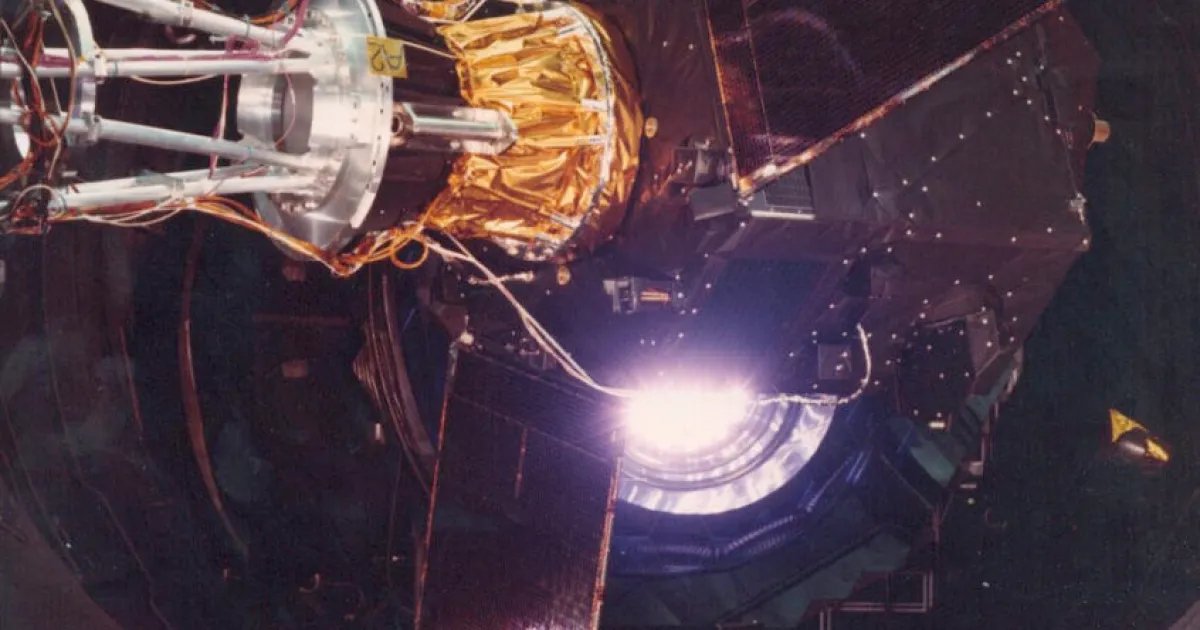
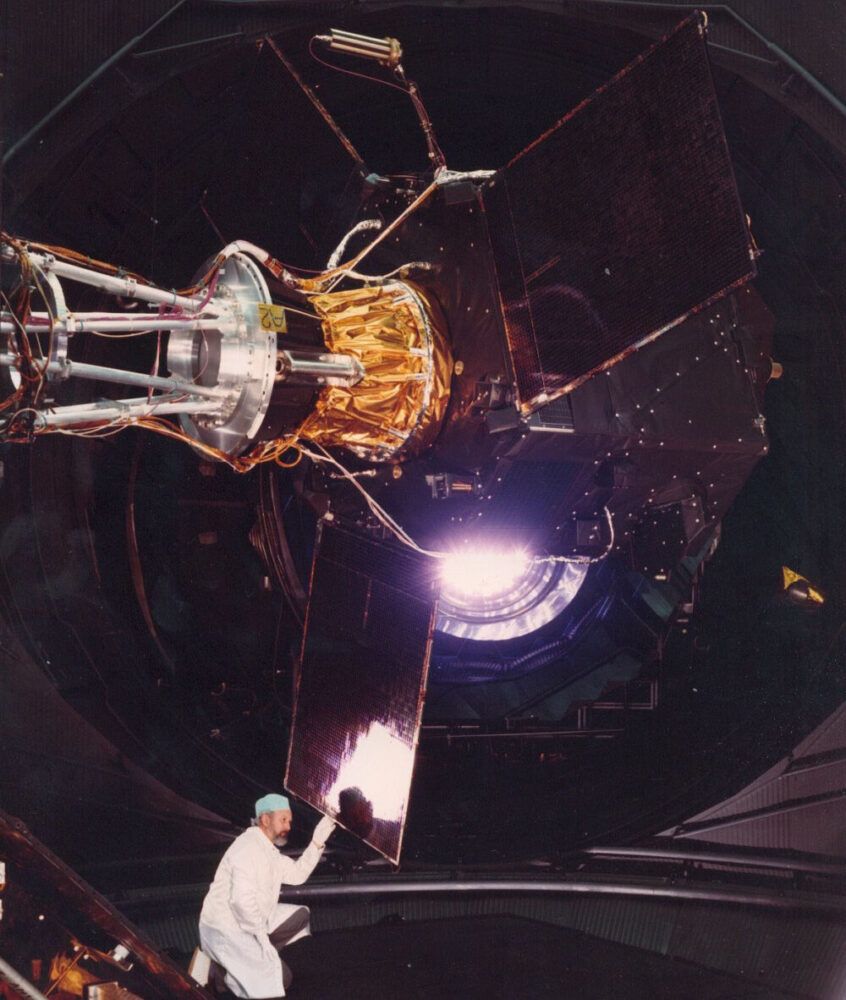
The Hipparcos satellite undergoes testing in the Large Solar Simulator at the European Space Research and Technology Centre in the Netherlands. Credit: Michael Perryman/Wikimedia Commons
A pioneer mission in astrometry – the measurement of the position, distance, motion, brightness, and color of stars – the European Space Agency’s (ESA) High Precision Parallax Collecting Satellite, or Hipparcos, launched on Aug. 8, 1989. There were immediately problems when a rocket-engine failure kept Hipparcos from reaching its planned orbit. However, the satellite was still able to operate, and the results it sent back to Earth were modified to take into account the new orbit. In addition to overcoming these setbacks, the mission also exceeded its goals of precisely measuring the astrometrics of 120,000 stars: The Hipparcos and Tycho catalogs of its results, published by ESA in 1997, contain data on over a million stars. The mission ended in 1993, with ESA developing Gaia as its star-measuring successor.
Elisa Neckar is senior production editor of Astronomy magazine, and the editor of the Today in the History of Astronomy feature on Astronomy.com.