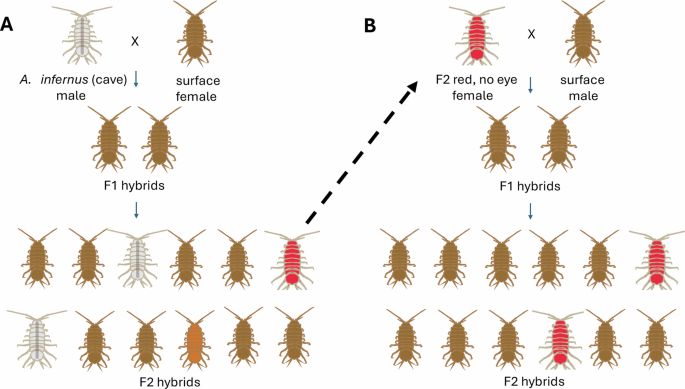
In this study, we crossed individuals from the Romanian cave population Asellus infernus with surface A. aquaticus to generate F₁ and subsequently F₂ hybrids. Genotype–phenotype association tests revealed that the same genomic regions previously linked to eye and pigment phenotypes in Slovenian cave populations (Protas et al., 2011; Re et al., 2018; Fišer et al., 2024) are also associated with the same traits in A. infernus (Table 4). This finding is striking given the considerable biogeographic and ecological distinctness of A. infernus compared to the Slovenian cave populations.
For the phenotypes of pigment absence and orange eye pigment, the results were consistent with those from the Slovenian cave populations, Old Subterranean Pivka and Subterranean Rak (Re et al., 2018). The pigmented versus unpigmented phenotype and the genomic region marked by scarlet showed a significant and similarly strong association (as measured by Cramér’s V) in A. infernus. Complementation crosses provide further support: a cross between a Subterranean Rak hybrid and A. infernus, as well as crosses among multiple Slovenian cave populations, indicate that the same gene likely underlies pigment loss across all populations examined (Protas et al., 2011; Re et al., 2018; Rodas et al., 2023; Fišer et al., 2024). The genomic region marked by nckx30 was also significantly associated with the orange eye pigment phenotype in A. infernus. The lower Cramér’s V observed in A. infernus (0.367), compared to the results from Slovenian cave populations, was expected, as some surface females used for the F₂ crosses were heterozygous for an orange allele (see Methods; Rodas et al., 2023). Previous complementation tests further support that the same gene likely underlies the orange eye pigment phenotype across both cave and surface populations in Romania and Slovenia (Rodas et al., 2023).
For the red eye pigment as well as eye (ommatidia) and head pigmentation pattern phenotypes, associations with pax2 and sob, respectively, were more variable and less consistent with those from the Slovenian cave populations. For the red eye pigment phenotype, the classical cave × surface F₂ cross showed a marginally significant and weak association with pax2 (p = 0.056, V = 0.334), in contrast to the Old Subterranean Pivka and Subterranean Rak populations where the association was strong and significant (Re et al., 2018). By contrast, the red-eyeless × surface F₂ cross revealed a significant and strong association of the phenotype of red eye pigment versus orange/brown eye pigment with pax2. A similar pattern was observed for sob: while both crosses showed a significant association with eye loss, only the red-eyeless × surface F₂ cross revealed a significant and strong association with head pigmentation pattern. These differences are probably due to the low statistical power of these specific tests for the classical cross (<0.60) but also likely reflect the influence of multiple loci, potentially interacting epistatically, on pigmentation phenotypes in A. infernus. Restricting the analysis to a subset of variation in the red-eyeless × surface F₂ cross may have reduced this complexity, uncovering stronger associations. Thus, our results also demonstrate the value of targeted F₂ designs—these are especially useful when multiple loci contribute non-additively to a trait. More surprising was the association of the heterozygous sob genotype with the eyeless phenotype in the classical cave × surface F₂ cross. At least one of the cave parents was heterozygous rather than homozygous for the cave allele, which may partially explain this result. However, it remains unclear why heterozygotes were disproportionately associated with eye loss. Potential explanations include structural variation such as inversions or translocations between cave and surface genomes, or selective survival of recombinants carrying compatible genomic regions.
The associations of eye (ommatidia) and head pigmentation pattern with fat facets were the least concordant with those from the Slovenian cave populations. Notably, fat facets showed no significant association with head pigmentation pattern in either cross, likely due to low statistical power of these tests (<0.41). It was, however, significantly but weakly associated with eye loss in the classical cross, and showed marginal significance (p = 0.065) for the same association in the red-eyeless cross. This latter discrepancy may again reflect a statistical artefact: the smaller sample size for fat facets in the red-eyeless cross translated to reduced statistical power (0.979 versus 0.480). Alternatively, we see two biological explanations. First, the markers tested are proxies and not the causal loci themselves, so recombination in the red-eyeless cross could have disrupted linkage. Second, inspection of the genotype distributions in the red-eyeless cross revealed a strong bias toward homozygous cave and heterozygous genotypes, with very few surface homozygotes. Genotyping of F₁ individuals further confirmed an unexpected pattern: some F₁s were homozygous for the cave allele despite having one surface and one cave parent, both homozygous for their respective alleles. A possible explanation is that this genomic region is haploid in some individuals, e.g., located on a sex chromosome. Existing evidence suggests that in Asellus, males are likely the heterogametic sex (Rocchi et al., 1984; Volpi et al., 1992), although the current knowledge is insufficient and things are complicated due to the common occurrence of sex changes via Wolbachia infestation (Vitagliano et al., 1994; Bouchon et al., 1998). Because our current genotyping cannot distinguish between hemizygous and homozygous states, such cases could produce misleading results. Resolving this will require methods capable of discriminating among all possible allele states, as well as sexing the F₁ hybrids.
Overall, the genomic regions previously identified in Slovenian populations appear to also play a role in A. infernus. However, it is likely that additional regions might also be involved in these traits; a genome-wide mapping approach will be necessary to uncover these. In the future, when genome-wide markers are identified between the Romanian cave and surface populations, it will be possible to perform QTL mapping of these traits. Additionally, the Romanian cave population reveals additional complexity not observed in the Slovenian cave hybrids. Unique pigmentation combinations were observed in A. infernus F2 hybrids, such as individuals with body and head pigmentation but no eye pigment, or individuals with dark eye pigment but little body or head pigmentation—phenotypes absent in Slovenian hybrids. Similar to the Slovenian populations, however, A. infernus hybrids displayed a wide spectrum of eye structure phenotypes, including individuals with intact ommatidia, ommatidial fragments, or various combinations of the two (Protas et al., 2011; Re et al., 2018). These differences could arise because not all relevant variation is fixed within cave populations, so the outcome of crosses depends on which individuals are sampled. Alternatively, A. infernus may harbor additional genetic variation not found in Slovenian cave populations. Identifying these novel loci will require genome-wide mapping approaches, but also a more robust breeding program. Historically, A. infernus has been difficult to maintain in the laboratory, and previous attempts with independent collections produced few or no F₂ offspring. In contrast, the batch described here produced robust F₁s and two lab-bred generations of cave × cave crosses. The greater number of F₂s may reflect the larger F₁ pool, but cave individuals in this collection also appeared more robust than in past efforts. Why this batch was more successful remains unclear. Future studies could test whether reproductive success varies with collection timing or with conditions better mimicking the natural sulfidic, thermal environment.
The observed genetic constraint for the same genomic regions underpinning eye and pigment phenotypes in both Slovenian cave populations and A. infernus is particularly striking given the highly distinctive nature of the latter. A. infernus is geographically distant (>1000 km), belongs to a different phylogenetic clade, and inhabits thermal (21 –23 °C), sulfidic waters (Konec et al., 2015; Sarbu et al., 2018; Protas et al., 2023). It primarily feeds on sulfur-oxidizing microbial biofilms and experiences minimal predation (Brad et al., 2021), in contrast to Slovenian cave populations, which mainly consume allochthonous detritus and face comparatively stronger predation from the olm, Proteus anguinus (Fišer et al., 2019; Benko et al., 2024). One explanation for genetic parallelism is that some of the causative variation derives from common standing genetic variation in surface populations (Rodas et al., 2023). Although Slovenian and Romanian surface lineages belong to different clades of the A. aquaticus species complex, the population size of both is large, and they dwell in similar environmental conditions. Thus, with minimal genetic drift and divergent selection, they might keep similar standing genetic variation. Alternatively, and not mutually exclusive, alleles underlying eye and pigment reduction may have pleiotropic effects that confer advantages in those ecological conditions that are common for all investigated populations, such as constant darkness or buffered seasonality (Pipan and Culver, 2012; Fišer et al., 2023). In particular, this could explain the repeated selection of variants (e.g., orange and red eye pigment, stellate head pigmentation pattern), that remain phenotypically masked in cave animals by the unpigmented phenotype.
Ultimately, a full understanding of repeated evolution in the A. aquaticus species complex will require identification of the exact genes and mutations underlying these traits. Such knowledge will clarify whether causative variation is still present in surface populations, reveal potential pleiotropic effects that drive repeated selection, and explain unusual genotypes observed in our crosses. Coupling this with forthcoming surface and cave genomes (Baković et al., 2021; Thomas et al., 2025) will enable tests of structural differences between cave and surface genomes and help resolve the role of genomic architecture in shaping eye and pigmentation phenotypes.