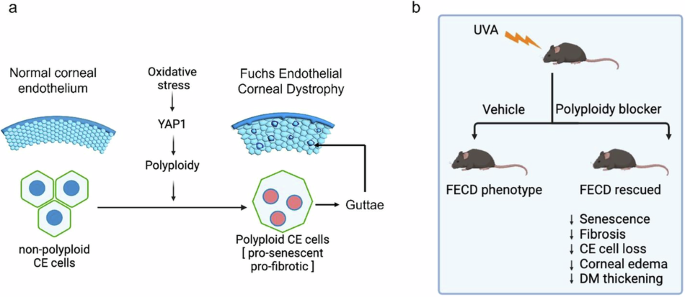
Fuchs endothelial corneal dystrophy (FECD) is a progressive disorder characterized by corneal endothelial (CE) cell loss and accumulation of extracellular matrix (ECM) excrescences (guttae) in Descemet’s membrane, leading to corneal edema and visual impairment. We previously demonstrated that ultraviolet-A (UVA) exposure induces oxidative stress and CE cell loss in a non-genetic murine model of FECD. Here, we investigated whether UVA triggers polyploidization, a conserved stress-adaptation mechanism observed in several post-mitotic tissues. Using our UVA-based FECD model, we performed temporal analyses of CE cell ploidy, and molecular markers associated with cell-cycle regulation and ECM deposition seen in FECD. UVA exposure induced oxidative DNA damage and apoptosis, resulting in decreased cell density. Surviving CE cells re-entered the cell cycle and underwent endocycling, generating enlarged polyploid nuclei in about 60% of cells with increased DNA content reaching up to 64 C by day 3, compared to 6 C at day 1 post-UVA. Early polyploidization served a compensatory role preserving tissue integrity following cell loss. However, persistent oxidative stress promoted progression toward endomitosis and multinucleation, accompanied by cellular senescence and fibrosis observed during disease progression. Mechanistically, UVA-induced cell-cycle re-entry and polyploidization were mediated by YAP1 and its downstream effectors, E2F1 and CDK2. Pharmacologic inhibition of YAP1 using the small-molecule CA3 suppressed polyploidization-associated multinucleation and reduced pro-fibrotic changes, ultimately mitigating CE cell loss in vivo. Together, these findings identify distinct early protective and later pathogenic roles of polyploidization in CE cells and highlight YAP1-mediated hyperploidization as a potential therapeutic target for FECD.

Fuchs endothelial corneal dystrophy (FECD) involves progressive corneal endothelial cell loss driven by oxidative stress. Using a UVA-induced mouse model, we show that surviving cells undergo YAP1-mediated polyploidization. While initially compensatory, persistent hyperploidization promotes senescence and disease progression. Inhibiting YAP1 reduces polyploidy and preserves endothelial cell survival, identifying a potential therapeutic target.